April 6, 2026 • Celeste Morrow • 9 min reading time • Prices verified June 4, 2026
Peptide and Collagen Face Creams: Parsing the Science From the Marketing on Your Moisturizer Label
If you’ve ever picked up a face cream at Sephora, flipped it over, and found yourself staring down a word like “palmitoyl tripeptide-1” or a bold claim about “boosting collagen by 47%,” you’re not alone — and you’re right to be skeptical. Peptides (short chains of amino acids that act as signaling molecules in the skin) and collagen (the structural protein that gives skin its firmness and bounce) have become the twin marketing pillars of the modern anti-aging moisturizer. The science behind them is real, but it’s also layered, and beauty brands have become very good at borrowing the vocabulary of dermatology without always delivering the clinical reality. This guide is here to close that gap. By the end, you’ll know which peptide classes have the strongest evidence, why topical collagen is a different conversation than you might expect, and how to apply a decision framework that works whether you’re eyeing a $38 drugstore pick or a $320 prestige serum-cream hybrid.
Why “Collagen Cream” Is Almost Always a Marketing Term — And What to Look for Instead
Let’s start with the claim that appears on more moisturizer boxes than almost any other: collagen. The premise sounds logical — skin loses collagen as we age, so applying collagen topically should replenish it. Allure’s editorial deep-dive on collagen creams explains the core problem clearly: collagen molecules in their full, unhydrolyzed form are simply too large to penetrate the stratum corneum (the outermost skin barrier). They sit on the surface, providing a temporary plumping and moisturizing effect through film-forming, but they cannot reach the dermis — the deeper skin layer where structural collagen actually lives.
This doesn’t make collagen an empty ingredient. Hydrolyzed collagen (collagen that’s been broken into smaller peptide fragments) and soluble collagen do provide real surface-level hydration benefits, and over time, that hydration can reduce the appearance of fine lines. It’s a legitimate cosmetic effect. But it is not “rebuilding your collagen matrix,” and any brand copy suggesting otherwise is overstating the evidence substantially.
The honest version of the trade-off:
| Claim Type | What It Usually Means | Evidence Level |
|---|---|---|
| ”Boosts collagen production” | May stimulate fibroblast activity via peptides | Moderate (ingredient-dependent) |
| “Contains collagen” | Typically surface hydration via hydrolyzed or soluble collagen | Well-established, limited depth |
| ”Rebuilds collagen matrix” | No topical cream achieves this alone | Overstated / marketing language |
| ”Clinically proven collagen increase” | Usually an in-house study; check methodology | Weak to moderate without peer review |
The more meaningful question is not whether a cream contains collagen, but whether it contains ingredients that can credibly influence collagen synthesis in the dermis — and that’s where peptides enter the picture in a much more interesting way.
Peptide Classes: The Three You Should Actually Know
Peptides in skincare are not a monolith. Paula’s Choice Skincare Education’s detailed overview of peptides identifies several distinct functional classes, and understanding the difference between them changes how you evaluate a formula entirely.
Signal peptides are the most clinically interesting category. These short amino acid chains (like palmitoyl tripeptide-1, palmitoyl tetrapeptide-7, and the well-studied palmitoyl pentapeptide-4, commercially known as Matrixyl) work by mimicking the degraded collagen fragments the skin produces after damage. When fibroblasts — the collagen-producing cells in the dermis — detect these fragments, they interpret it as a signal to ramp up new collagen synthesis. Cosmetics and Toiletries’ technical review of topical peptide mechanisms notes that palmitoyl pentapeptide-4 in particular has multiple in-vitro and some in-vivo studies supporting measurable increases in collagen I, collagen III, and fibronectin production. The concentrations matter: effective signal peptide concentrations typically appear in the 3–10 ppm range in a finished formula, which is why you need these ingredients placed meaningfully high on an ingredient deck, not as window dressing near the preservatives.
Carrier peptides like GHK-Cu (copper peptide) don’t just signal — they deliver trace minerals that serve as enzymatic cofactors in collagen synthesis. GHK-Cu in particular has attracted significant dermatological attention; Byrdie’s comprehensive guide to skincare peptides cites a range of studies suggesting copper peptides may also support wound healing and antioxidant activity. The trade-off: copper peptides are pH-sensitive and can be destabilized by direct combination with high-dose vitamin C or retinoids in the same formula, which is a meaningful formulation detail when you’re stacking products.
Neurotransmitter-inhibiting peptides (argireline/acetyl hexapeptide-3 being the most famous) are marketed as topical alternatives to neurotoxin injections, with claims of relaxing repeated facial muscle contractions. Self’s dermatologist-sourced roundup of peptide moisturizers addresses these candidly: the evidence for meaningful real-world effect from topical application is weak. Penetration challenges and concentration limits in leave-on formulas mean the effect, if present, is minor. They’re not harmful, but they probably shouldn’t be the primary reason you’re paying a premium.
By the numbers:
- Palmitoyl pentapeptide-4 (Matrixyl) has peer-reviewed studies showing up to ~35% reduction in wrinkle depth after 56 days in some in-vivo trials (Cosmetics and Toiletries reference; study by Sederma, manufacturer disclosure).
- Effective GHK-Cu concentrations in clinical studies typically range from 0.1% to 1% of the finished formula.
- Topical collagen molecules: native collagen MW is ~300,000 Da; skin penetration generally requires <500 Da. Hydrolyzed fragments vary widely.
Reading an Ingredient Deck Like Someone Who’s Done This Before
By the time you’re evaluating a $180 peptide cream against a $55 alternative, the marketing copy on the front is largely irrelevant. The INCI list (International Nomenclature of Cosmetic Ingredients — the standardized ingredient list on the back of every product sold in regulated markets) is the actual document of record.
A few practitioner-level reads to make:
Peptide placement matters. Ingredients are listed in descending order of concentration. If your four-peptide formula lists all four peptides in the last 20% of the INCI list, below fragrance and below most preservatives, the concentrations are likely cosmetically trivial. The signal peptides that have clinical backing need to be present at efficacious levels — and the formulator made choices about that. Byrdie’s guide notes this explicitly: a long peptide list near the bottom of the deck is frequently a marketing artifact, not a functional formula.
The vehicle is part of the formula. Peptides, particularly copper peptides, are most effective in certain pH ranges (typically 6–7 for GHK-Cu) and require appropriate delivery systems. A peptide in a poorly formulated base — wrong pH, incompatible co-ingredients, inadequate emollients for penetration enhancement — is a peptide that doesn’t perform. This is why two creams with technically identical peptide ingredients can behave differently on skin. Dermatologists cited in Self’s roundup consistently emphasize this: the elegance of the base formulation is often what separates a $40 drugstore peptide cream from a $200 prestige one, not just marketing margin.
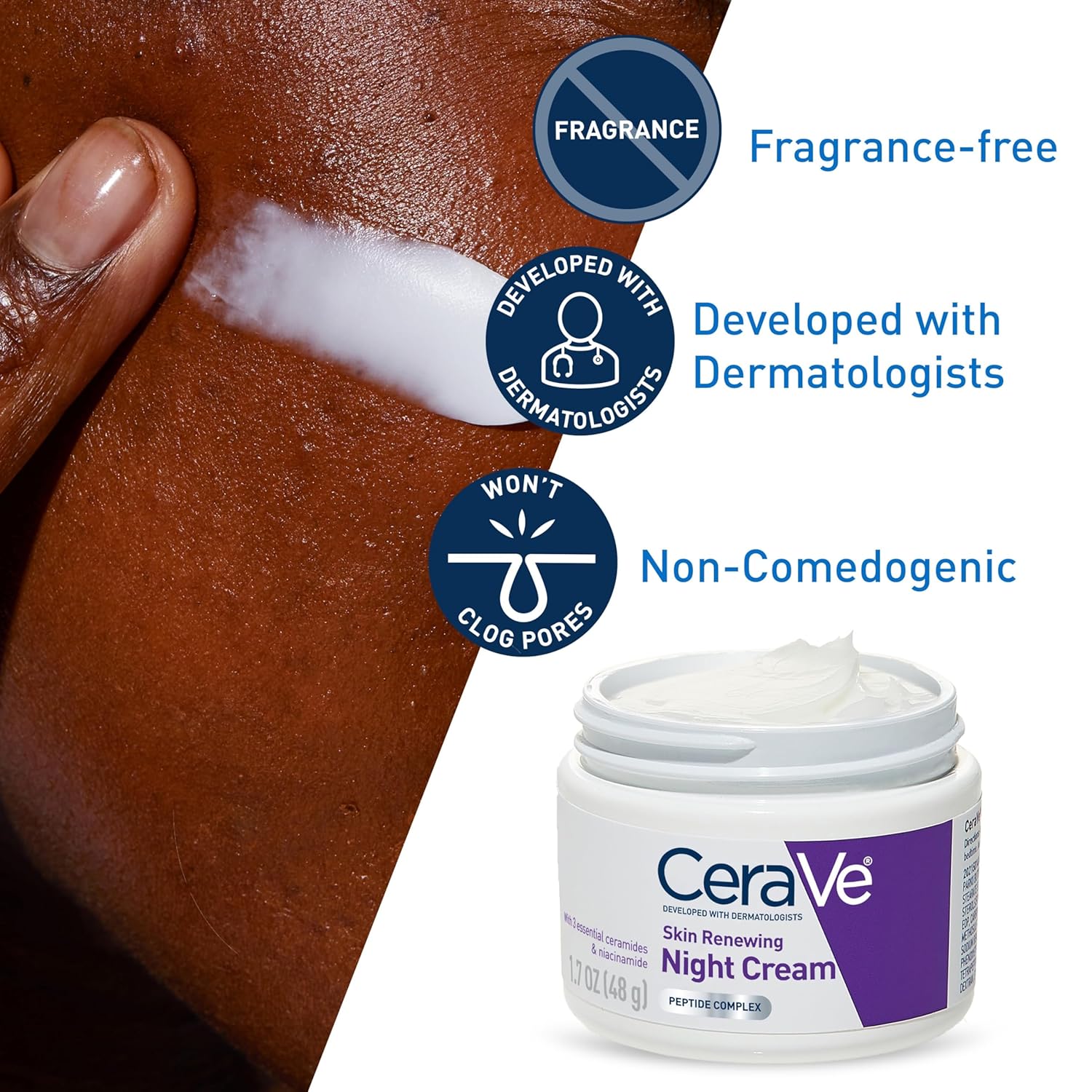
What “fragrance-free” and “essential-oil-free” actually signal. EWG’s Skin Deep database classifies several common fragrance constituents as moderate sensitizers, and fragrance is a meaningful formulation choice in peptide creams specifically — because many long-term peptide users are also using retinoids or exfoliating acids, which increases sensitization potential. Fragrance-free formulas aren’t necessarily better, but for a sensitized or compromised barrier, they reduce compounding irritation risk.
The retinol coexistence question. Peptide creams and retinoids are often layered in the same routine. The main caveat: certain peptides (especially copper peptides) can be deactivated by retinol or low-pH vitamin C when mixed directly. The practical solution most dermatologists recommend, as noted in Byrdie’s skincare layering coverage, is AM/PM separation — vitamin C and retinoids in one window, peptide-forward moisturizers in the other. This is not a reason to avoid either; it’s a reason to sequence thoughtfully.
The Price-Per-Use Framework: When the Splurge Is Justified
This is where intermediate practitioners tend to make their best and worst calls, because the correlation between price and peptide efficacy is real but not linear — and the premium tier has legitimate reasons to cost more that have nothing to do with the active ingredients.
A $38 drugstore peptide moisturizer with palmitoyl pentapeptide-4 listed at a functional position and a clean, fragrance-free base is doing real work. A $290 prestige peptide cream might offer better texture, a more sophisticated delivery system, additional actives (growth factors, ceramide complexes, stabilized retinol), or a validated 12-week clinical study — or it might largely be packaging, brand positioning, and the cost of a Nordstrom or Sephora retail partnership. The label doesn’t tell you which.
The cost-per-use math is worth running. A 50ml jar of a $180 peptide cream used as a full-face daily moisturizer typically lasts 60–90 days, putting daily cost at $2.00–$3.00. At that range, the “worth it” calculus depends on what the formula is actually delivering beyond what a well-formulated $55 alternative already provides — and that’s a question the INCI deck and third-party ingredient analysis answer better than the marketing copy.
If X, then Y — the decision framework:
-
If your goal is basic collagen-support moisturization with verified signal peptides: A mid-range formula ($40–$80) with palmitoyl pentapeptide-4 or Matrixyl 3000 complex (the palmitoyl tripeptide-1 / palmitoyl tetrapeptide-7 pair) at a meaningful deck position will deliver credible results. Budget for a separate retinoid if anti-aging is the core priority.
-
If you’re managing a sensitized or compromised barrier and want peptides without irritation risk: Prioritize fragrance-free, essential-oil-free formulas; look for ceramide or fatty acid co-ingredients to support barrier function; copper peptide products may be especially useful given the wound-healing and anti-inflammatory data.
-
If you’re considering a $200+ peptide cream: The premium is justified when the formula includes additional clinically supported actives (stabilized retinol, growth factors, bakuchiol, advanced ceramide complexes), when the delivery system is proprietary and validated, or when texture and sensory experience has material value to your compliance (because a product you’ll use daily beats a better product you abandon). It is not automatically justified by peptide count or brand prestige.
-
If a brand is making dramatic collagen-rebuilding claims: Treat it as a red flag, not a selling point. Well-formulated brands with actual clinical backing tend to make more measured claims — “supports skin’s natural collagen production” rather than “reverses collagen loss.” The latter is not currently achievable with a topical cream alone.
The underlying rule across all of this: the ingredient deck is the product. The marketing copy is an opinion about the product. You’re shopping for ingredients, not opinions — and now you have the framework to tell the difference.