June 3, 2026 • Celeste Morrow • 9 min reading time • Prices verified June 4, 2026
Hyaluronic Acid Serums: Why Molecular Weight and Layering Order Change Everything
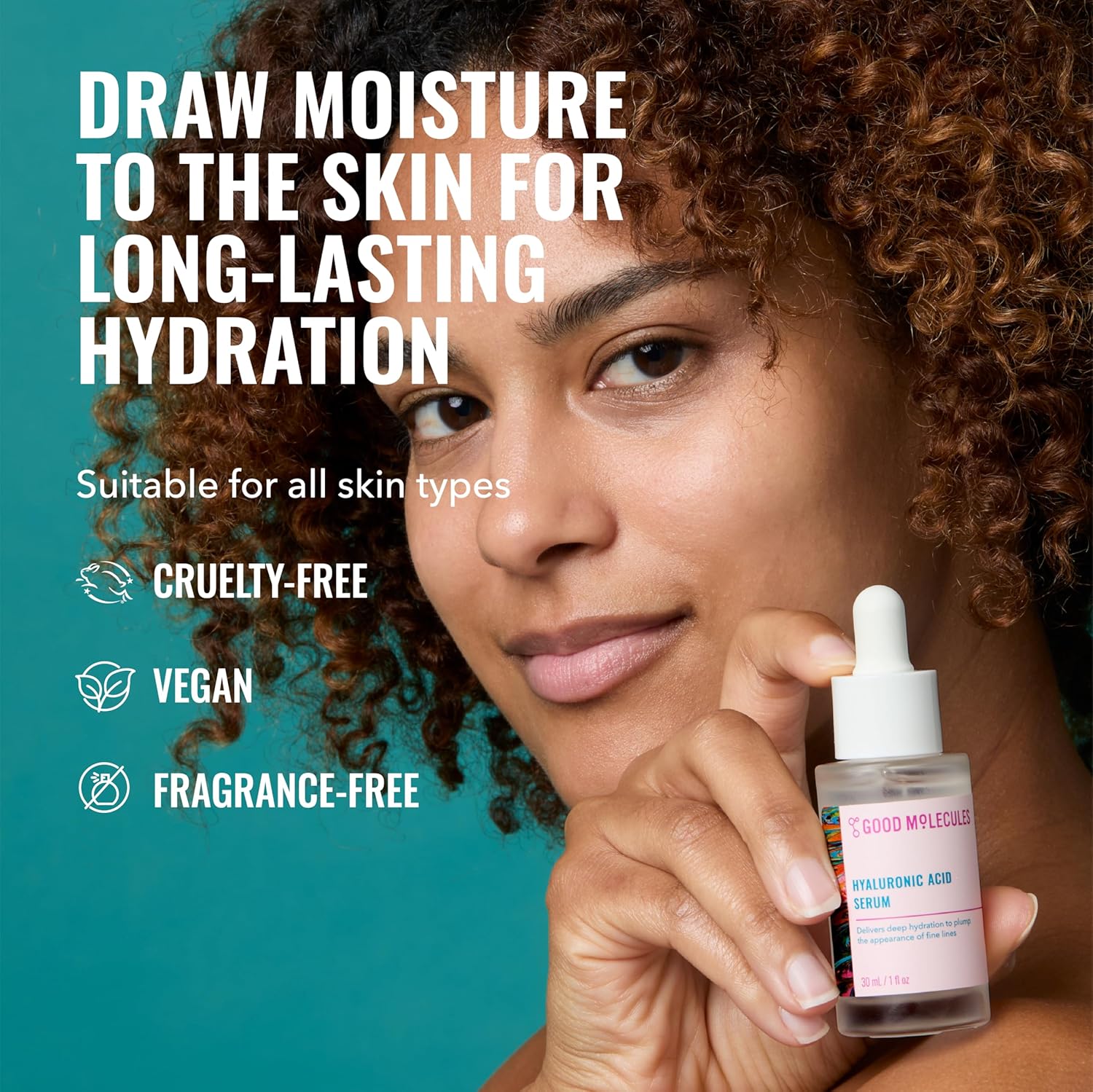
Hyaluronic acid is one of the most common ingredients in serums right now — you’ll find it in formulas from a $14 drugstore bottle all the way to a $320 prestige treatment. The name sounds technical, but the concept is simple: hyaluronic acid (HA) is a molecule your skin makes naturally to hold water. As a topical ingredient, it acts like a sponge, drawing moisture toward itself and helping skin look plumper and less tight. The problem is that “hyaluronic acid serum” on a label tells you almost nothing useful. The size of the molecule — its molecular weight — determines how deeply it can penetrate, and the order you apply it in your routine determines whether it actually gets moisture in or just sits on top doing very little. If you’ve ever bought a well-reviewed HA serum and felt like it wasn’t doing anything, molecular weight and layering order are almost certainly why.
This guide breaks down what the research and long-term reviewers consistently report, gives you the math on what you’re actually buying across price tiers, and ends with a clear decision framework so you can shop — or re-sequence your current routine — with confidence.
Molecular Weight Is the Spec That Actually Matters
Think of molecular weight as the size of the key relative to the lock. Hyaluronic acid molecules are measured in Daltons (Da) — a unit of atomic mass. The larger the number, the bigger the molecule, and the less able it is to pass through the outer skin barrier.
High molecular weight HA (above 1,000 kDa): Sits on the skin’s surface and forms a film. It creates the immediate “plump” sensation you feel minutes after applying a serum. It’s a legitimate benefit — surface hydration reduces the look of fine lines temporarily and helps prevent transepidermal water loss (TEWL), meaning it slows the rate at which moisture evaporates from your skin into the air. Paula’s Choice’s ingredient glossary notes this surface-acting behavior directly and describes it as a conditioning agent rather than a deep treatment.
Medium molecular weight HA (50–1,000 kDa): Penetrates into the upper layers of the epidermis (the outermost layer of skin). This is the range most associated with sustained, visible plumping effects over days of consistent use rather than just the hour after application. Byrdie’s comprehensive hyaluronic acid guide highlights this mid-range as the “workhorse” of multi-weight formulas.
Low molecular weight HA (below 50 kDa): Reaches deeper into the dermis (the layer below the epidermis, where collagen lives). The trade-off: some dermatologists cited in Allure’s HA overview flag that very low molecular weight fragments can, in some skin types, trigger a mild inflammatory response — the immune system reads small HA fragments as a signal of tissue damage. This is rare at cosmetic concentrations but worth knowing if your skin is reactive.
Sodium hyaluronate: This is the salt form of HA and the version you’ll see listed on most ingredient decks. It’s smaller and more stable than pure hyaluronic acid, penetrates slightly better, and is less expensive to synthesize. For practical purposes, it performs comparably to HA of equivalent molecular weight. Don’t let the different INCI name (the standardized international ingredient naming system) confuse you — it’s doing the same job.
By the Numbers
| Molecular Weight | Penetration Depth | Primary Benefit | Common Formulas |
|---|---|---|---|
| >1,000 kDa | Surface only | Immediate plump, barrier film | Budget to mid-range single-weight |
| 50–1,000 kDa | Upper epidermis | Sustained hydration, extended plump | Most prestige multi-weight serums |
| <50 kDa | Dermis | Long-term structural support | Clinical and luxury treatments |
| Crosslinked HA | Surface + slow release | Extended wear, less washoff | Some primers and day serums |
The practical implication: a serum listing only “hyaluronic acid” or “sodium hyaluronate” without specifying weight — and without a “multi-weight” or “triple-weight” marketing claim — is almost certainly a single high-molecular-weight formula. That’s not a fraud, but it is a surface treatment. If your goal is anything beyond same-day dewiness, you’re shopping in the wrong lane.
Why Layering Order Determines Whether HA Works or Backfires
Here’s the trade-off that most HA serum users don’t know until they’ve wasted a few bottles: hyaluronic acid is hygroscopic, meaning it pulls water from whatever environment is closest to it. In a humid climate, it draws moisture from the air into your skin. In a dry environment — a heated office, an airplane cabin, a low-humidity climate — it pulls moisture from the deeper layers of your skin outward, which can leave skin drier than before you started. Dermstore’s editorial on layering actives flags this explicitly as one of the most common HA misuse patterns they hear about from readers.
The fix is not complicated, but it requires precision:
Step 1: Apply HA to damp skin. After cleansing, apply your HA serum while your face is still slightly wet — not dripping, but not fully dried off. You’re giving the molecule something to latch onto that isn’t your own deeper tissue. Reviewers across aggregated long-term reviews consistently rate this single change as more impactful than switching to a more expensive formula.
Step 2: Seal immediately with an occlusive or emollient. An occlusive is any ingredient that forms a physical barrier — think petrolatum, dimethicone, or heavier plant oils — that slows evaporation. An emollient softens and fills in the spaces between skin cells. Moisturizers, facial oils, and most day creams contain both. The window between applying HA and applying your moisturizer matters: longer than 60 seconds in a dry environment and you’re risking that backfire effect. Apply your serum, count to 30, apply your moisturizer. That’s the entire protocol.
Step 3: HA goes under, not over, other actives. This is the sequencing error that creates the most buyer frustration at prestige price points. A common routine mistake: applying a vitamin C serum (typically water-based, applied first), letting it dry, then applying HA, then moisturizer. The problem is that HA applied over a mostly-dried vitamin C serum has less moisture available to bind. The better sequence for most multi-active routines is: cleanser → toner (if using) → HA serum on damp skin → wait 30 seconds → vitamin C or niacinamide if they’re in a separate serum → moisturizer → SPF (AM) or face oil (PM). Byrdie’s layering guidance supports this sequence and notes that the thin, watery texture of most HA serums means they should nearly always be your first serum application.
Shopping the Tiers: What More Money Actually Buys
The price spread for HA serums in 2026 runs from roughly $12 to $320+. Here’s what the premium actually buys, and where it doesn’t change outcomes.
$12–$30 (The Ordinary, Neutrogena, CeraVe range): These formulas reliably deliver high-molecular-weight HA or sodium hyaluronate at effective concentrations. The Ordinary Hyaluronic Acid 2% + B5 is arguably the most discussed single HA formula in any price tier, and reviewers at Allure consistently return to it as a baseline recommendation for first-time HA users. At this price, you’re not getting multi-weight delivery, and the texture and feel are utilitarian. That’s a fair trade for many routines.
$35–$90 (SkinCeuticals H.A. Intensifier, Vichy Minéral 89, Tatcha Plump range): This is where multi-weight HA systems start appearing reliably. SkinCeuticals H.A. Intensifier — around $100 at Dermstore and Nordstrom — is one of the more well-documented formulas in this category, with its proxylane (a HA-biosynthesis booster) addition giving reviewers something to point to beyond the HA itself. Paula’s Choice notes the supporting ingredient story in this tier is often more meaningful than the HA concentration alone. If you’re treating persistent dehydration lines rather than just same-day dryness, this tier earns its step up.
$100–$320+ (La Mer Concentrate, Augustinus Bader The Cream, Clé de Peau Serum): At this tier, HA is typically one component of a broader ingredient system rather than the hero molecule. Paying $320 for an HA delivery mechanism alone is almost never rational — you’re paying for the co-actives, the brand’s clinical research investment, and in some cases the delivery technology (encapsulated HA, time-release formats, crosslinked HA). These are legitimate differentiators for specific goals — a reviewer on Into The Gloss once described Augustinus Bader’s approach as “a complete system where HA is the vehicle, not the destination” — but if your primary unmet need is basic hydration, this tier is overshooting.
The decision rule: If you’re addressing dehydration lines and want more than 24-hour results, shop the $35–$90 multi-weight tier and layer correctly before upgrading. If you’re already in that tier and still disappointed, correct your application protocol (damp skin, immediate occlusion) before attributing the gap to the formula.
If X, Then Y: Your Decision Framework
If your skin feels dry immediately after applying your current HA serum: You’re likely applying to dry skin in a low-humidity environment. Switch to damp-skin application and seal within 30 seconds. No new product required.
If you see good same-day dewiness but no lasting change over weeks: Your formula is probably single high-molecular-weight HA. Move to a multi-weight formula in the $40–$90 range. SkinCeuticals H.A. Intensifier and Vichy Minéral 89 are the two names reviewers and estheticians cite most consistently at that tier.
If your skin is reactive or you’ve had flushing or sensitivity with HA serums before: Stick to high-molecular-weight formulas only. Avoid anything marketed specifically for its “deep penetration” until you’ve consulted a dermatologist about whether low-weight HA fragments are triggering a response.
If you’re already using a $90+ multi-weight formula and still underwhelmed: Before you go up in price, audit your layering order. HA applied over dry skin, or sealed too slowly, underperforms regardless of formula quality. Fix the protocol first — it costs nothing and, based on aggregated reviewer patterns, resolves the majority of “this serum does nothing” complaints.
If you’re building a routine from scratch and budget is a constraint: Start with The Ordinary Hyaluronic Acid 2% + B5 and a solid moisturizer applied immediately after. Get the technique right at low cost before investing in a multi-weight system. The technique is the multiplier. The formula is secondary.